


SPAIN
Spain, the one you don't expect
7 days
Madrid - Sigüenza - Albarracín - Teruel - Cuenca - Madrid
7 days / 6 nights - Group tour by coach with a local guide from PODIUM Tour Operator.
Every leg of this journey has a story, a tale, and a surprise. The route takes you through the Serranía Celtibérica, one of the quietest areas in Europe, also known as the “Spanish Lapland.” It’s a place of untamed nature where rivers carve out canyons and the rock has helped shape medieval villages.
Recommended travel periods: February–May and September–November.
Day 1: Madrid (20 km)
The capital that began as a fortress.
Our journey begins in Madrid, a city founded in the 9th century as a Muslim fortress called Mayrit.
It was in 1561 that Philip II moved the court there from Toledo and made it the capital.
At an elevation of about 650 meters, Madrid is one of the highest-altitude capitals in Europe, with cold winters, very hot but dry summers, and significant daily temperature fluctuations.
The guided tour includes: the Puerta del Sol, the vibrant heart of the historic centre, home to the Casa de Correos clock, where people eagerly await the Spanish New Year’s Eve celebration. At the beginning of Calle de Alcalá stands the bronze statue of the Bear and the Strawberry Tree (El Oso y el Madroño), a symbol of the city.
In front of the Real Casa de Correos stands one of Madrid’s most photographed landmarks: the Kilómetro Cero plaque. Set into the pavement, it marks the starting point of Spain’s six national highways. Tradition has it that tourists step on or walk around the Kilómetro Cero plaque to begin their journey.
The Plaza Mayor, the San Miguel Market (1916) (which is designated a Monument of Cultural Interest) the Royal Palace, and the Almudena Cathedral, which was blessed by Pope John Paul II on June 15, 1993, becoming the first cathedral consecrated outside of Rome.
For a snack: a typical treat of hot chocolate with churros madrileños (cylindrical, fluted fried dough sticks made from a batter of water, flour, and salt) at a historic chocolate shop in the city centre.
Dinner features cocido madrileño, the region’s signature dish, served in three courses (broth, chickpeas and vegetables, and meat).
Day 2: Madrid – Alcalá de Henares – Sigüenza (135 km)
From the city to silence.
As we leave Madrid, the buildings give way to the countryside, which immediately immerses us in scenes from a famous travel book written in 1948 by the Spanish writer and Nobel Prize winner Camilo José Cela: “Journey to La Alcarria” (Viaje a la Alcarria).
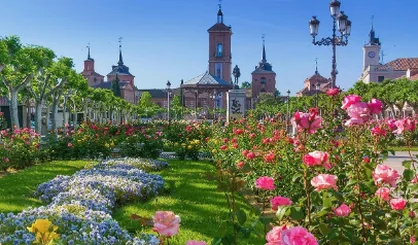
Continuing with this literary theme, we stop in Alcalá de Henares, the birthplace of the great playwright and poet Cervantes (1547), famous throughout the world for his “Don Quixote of La Mancha.”
Dining in Alcalá: a tasting of traditional pastries such as rosquillas (traditional doughnuts dating back to the 16th century, consisting of rings of crispy puff pastry double-coated with an egg yolk cream and a sugar glaze) and costrada (a crispy mille-feuille-style pastry with cream and meringue).
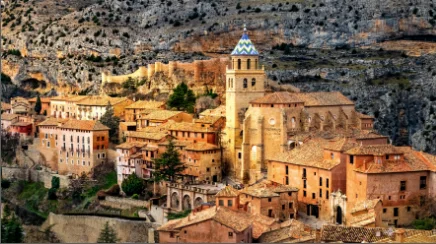
Afternoon in Sigüenza, located in the northern part of the province of Guadalajara, with a magnificent architectural heritage designated a Historic-Artistic Site in 1965.The Castle, now a Parador; the Romanesque and Gothic-style Cathedral; and the Plaza Mayor, with its streets lined with stunning buildings that shift in colour with the light.
For dinner: cordero asado (lamb roasted in a wood-fired oven), migas (crumbled bread sautéed with bacon and peppers), and sheep’s-milk cheeses. Dessert? Alcarria PDO honey on fresh cheese.
Day 3: Río Dulce – Molina de Aragón – Albarracín (240 km)
Today, Spain takes on a new perspective.
We head toward the Río Dulce Canyon.
A short excursion to Pelegrina, a charming village with a castle perched on a bend in the river, in the Barranco del Río Dulce Natural Park. Gyrfalcons soar above the cliffs, large birds of prey riding the warm air currents.
Toward the southeast, the plateau widens, the villages grow sparse, and the sky suddenly seems vast. We’ve entered the heart of the Serranía Celtibérica, often compared to Lapland due to its low population density; a journey into silence.
Stop at the foot of Molina de Aragón Castle, one of the largest in Spain, followed by a stroll through the charming medieval town.
The Alto Tajo Natural Park is one of the finest examples of Castile-La Mancha’s biodiversity. This natural area boasts the most extensive network of gorges and meanders in Castile-La Mancha.
At sunset, take a stroll through Albarracín, where the shadows of the walls stretch up along the ridge and the village takes on a rosy hue.
On the menu: Ternasco de Aragón PGI (native lamb) with baked potatoes. During the colder months, we also recommend a dish featuring black truffles from Teruel.
Day 4: Albarracín and the Sierra (50 km)
The pink village, the paintings of early humans, the river that flows all the way to Lisbon.
A stroll through the narrow streets of the village of Albarracín, a National Monument since 1961.
Fun fact: The pink colour of the houses comes from local materials chalk and red clay. The walls wind along the ridge like a stone serpent, with the Torre del Andador keeping watch. The Casa de la Julianeta, narrow and sloping, is one of the most photographed sights.
A short bus ride to the Sierra, a protected natural area featuring the Pinares de Rodeno, pine forests on red sandstone cliffs, a masterpiece of natural beauty.
Guided tour of the Levantine cave paintings, a UNESCO World Heritage Site and an important example of prehistoric art. The scenes depicting hunting and daily life, painted thousands of years ago, are particularly remarkable.
A fascinating fact about the landscape: four rivers originate in the nearby Montes Universales, he Tagus (the longest on the Iberian Peninsula, flowing all the way to Lisbon), the Júcar, the Cabriel, and the Turia. This plateau is a vast reservoir of water.
Cuisine: migas, trucha (trout), or Teruel ham, served with bread and olive oil from Bajo Aragón (PDO). For dessert, suspiros de amante, an almond-based dessert linked to the legend of Teruel.
Day 5: Albarracín – Teruel (40 km)
Towers, love, flavours.
Teruel is famous for its Mudéjar style, born from the collaboration between Muslim artisans and Christian patrons. The towers of San Martín and El Salvador, UNESCO World Heritage Sites, are decorated with green, white, and purple ceramics that create harmonious geometric patterns of light.
Fun fact: Legend has it that two Muslim master builders competed for the love of the same woman, each erecting a tower.
Culinary highlights: sample Teruel PDO ham, the first Spanish ham to receive a protected designation of origin in 1984. If your trip takes place in February, you can experience the medieval festival of the Bodas de Isabel de Segura (dates to be confirmed).
Day 6: Teruel – Cuenca (150 km)
Forests, rocks sculpted by water, and a picture-perfect finish.
From the province of Teruel, we cross plateaus and pine forests toward the Serranía de Cuenca: streams, and white and grey rocks shaped by karst erosion. Here, we learn about the lives of the gancheros, the river workers who, until just a few decades ago, guided logs down the rivers to the sawmills downstream. This gruelling trade, practiced for five centuries from the Middle Ages through the mid-20th century, has been officially inscribed by UNESCO on the Representative List of the Intangible Cultural Heritage of Humanity.
We stop in a rural village to meet a cheese and honey producer.
In the late afternoon, arrival in Cuenca, an iconic city perched atop its cliffs and overlooking two gorges with its “Casas Colgadas” (hanging houses).
For dinner: pisto manchego, a stew made with diced seasonal vegetables, slowly cooked over low heat in olive oil and often enriched with a pinch of paprika (pimentón). It’s traditional to serve pisto with a fried or poached egg on top, accompanied by rustic bread.
Day 7: Cuenca – Madrid (165 km)
The return journey, with Spain in our hearts.
Visit to an artisan workshop. Transfer to Madrid.
For a break: pan con tomate y aceite, a must-try as a final taste of Spain.