


TUSCANY
Authentic Maremma and Giglio Island
5 days
Day 1: From the ancient Etruscan city of Roselle to the medieval heart of Grosseto (25 km)
Roselle is a town nestled on a hill; it was one of the twelve major city-states of the Etruscan League.
We walk up along the picturesque path of the Cyclopean walls, about three kilometres of enormous polygonal blocks skilfully fitted together without mortar. From here, the view opens up onto the Maremma plain, where Lake Prile once stretched inland, and you immediately understand why the Etruscans chose this strategic spot: to see, to monitor, and to admire.
Walking along the cobblestone streets of the Roselle Archaeological Park, we come across archaic huts dating to the 7th century B.C., of which only the stone foundations remain. The tour then reveals the subsequent Roman layout, featuring the town forum, which retains the intimate atmosphere of a small provincial town, and the splendid Domus dei Mosaici, where the floors bear witness to the opulence of a wealthy family of that era. The path continues toward the amphitheatre, small and intimate, with stone steps gently emerging from the grass. In 294 B.C., the city fell under Roman control but continued to thrive for centuries, evolving during the early Christian and medieval periods. In 1138, the bishop’s seat was officially moved to Grosseto at the behest of Pope Innocent II.
In the afternoon, we delve into the heart of the historic centre, enclosed by the Medici walls built between 1574 and 1593, which have remained almost intact, with six bastions forming a hexagon. Piazza Dante, with its monument to Grand Duke Leopold II of Lorraine, remembered for his land reclamation projects. San Francesco, with the Crucifix attributed to Cimabue, which is striking for its portrayal of human suffering; the Cathedral of San Lorenzo, dating back to the 13th century; and the Archaeological and Art Museum of the Maremma.
Gastronomy: Maremma-style tortelli with ragù, acquacotta (the simple soup of the cowboys and charcoal burners, made with bread, vegetables, and egg), and a glass of Morellino di Scansano DOCG.
Day 2: Giglio Island, granite by the Sea (50 km to Porto Santo Stefano; ferry; 20 km bus tour)
The day begins on the ferry deck: Monte Argentario recedes into the distance, and after about an hour, Giglio emerges like a block of golden granite.
Giglio Porto welcomes us with pastel-coloured houses, boats, and a small pier. Then the bus climbs, hairpin turn after hairpin turn, through Mediterranean scrub and terraced vineyards. Giglio Castello is a gem perched on the ridge at about 400 meters, with Pisan fortifications, stepped alleyways, arches, and houses built close together. Its views exude an ancient and profound history, marked also by difficult times, such as the historic raid by the pirate Barbarossa in 1544.
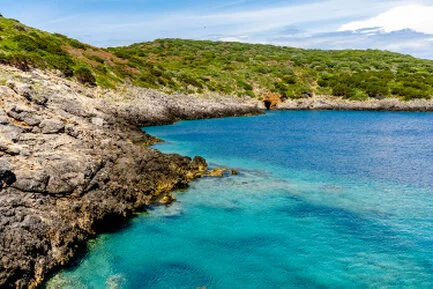
Campese Bay is the sunny side of the island, with a crescent of light-coloured sand and granite cliffs. The watchtower stands out above the bay, a symbol of an island that for centuries has lived with its eyes on the sea.
The island is also linked to the Costa Concordia shipwreck in January 2012: the people of Giglio responded with a generous welcome, and this tragic event deserves a moment of shared respect.
For lunch, fresh fish. Tasting: Ansonaco (Ansonica) from Giglio, an amber-coloured white wine grown on terraces overlooking the sea, the result of heroic, entirely hand-crafted viticulture. To finish, panficato, a rustic dessert made with dried fruit and raisins.
Day 3: Maremma Park, the wild heart (15 km from Grosseto to Alberese, about 30 km within the park)
Established in 1975, the park is one of the most authentic places in Tuscany. We will travel along the “road of the ranches,” where cowboys on horseback herd Maremma cow with their large, lyre-shaped horns and Maremma horses.
We continue toward the sea with a walk through the pine forest, one of the park’s easiest trails, all the way to the mouth of the Ombrone River. Here, remnants of the ancient marshes remain, a landscape of water, reeds, and birds where you can experience the Maremma’s original character. On the Uccellina hills, you can also see the coastal towers and the ruins of the medieval Abbey of San Rabano.
You can’t talk about the Maremma without mentioning Dante: in *Purgatorio*, Pia de’ Tolomei says, “Siena made me, the Maremma destroyed me.” For centuries, malaria made this land a symbol of hardship, but today it has become a natural treasure.
Lunch at a farmhouse: pappardelle with wild boar sauce, scottiglia, sheep’s-milk cheeses, and sciapo bread—the traditional unsalted Tuscan bread.
In the afternoon, a demonstration of horse training by a “buttero”: an ancient art requiring patience and respect for the animal.
Practical note: Access to the park is restricted; please contact PODIUM to make a reservation well in advance.
Day 4: Pitigliano, Sovana, and Sorano, the tuff towns (190 km, hotel in Grosseto)
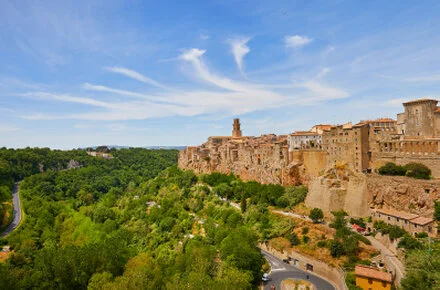
Pitigliano seems to rise directly from the rock; the houses and the cliff share the same warm colour of tuff. You enter through the 16th-century Medici aqueduct and walk through the narrow streets to the Jewish quarter. Here, because of its historic community, Pitigliano is called “Little Jerusalem,” where we’ll visit the synagogue (16th century), the bakery, and the cellars carved into the rock.
Sovana is a tiny village steeped in history: Ildebrando, the future Pope Gregory VII, was born here. Just outside the village, nestled in the woods, lies the Tomba Ildebranda, a monumental Etruscan tomb considered one of the most evocative in Italy.
Sorano overlooks the cliff where the Orsini fortress stands. For those with energy to spare, we recommend a walk through one of the *Vie Cave*, deep roads carved by the Etruscans into the tuff, up to twenty meters high, where light filters through in thin rays.
Must-try foods: “sfratti,” Jewish pastries made with walnuts and honey whose name recalls a painful historical episode; handmade “pici”; and… white wine Bianco di Pitigliano DOC.
Day 5: Vetulonia and Castiglione della Pescaia, Farewell (65 km)
Vetulonia is one of the oldest cities in Etruria, a thriving lucumonia that dominated maritime trade. The journey through time begins in the heart of the medieval village at the “Isidoro Falchi” Civic Archaeological Museum (MuVet), named after the archaeologist and physician who identified the site in the 19th century. Outside the museum, the Tomba della Pietrera and the Tomba del Diavolino feature the typical false domed vaults. From here, you can admire the plain where Lake Prile once lay.
Castiglione della Pescaia is the ideal finale to this tour, a seaside village with an imposing medieval castle perched atop the hill and, at its foot, a lively harbour-canal where boats are lined up as if in a watercolour painting.
The farewell lunch features spaghetti with clams, a variety of fried fish, and Vermentino white wine.
Alternative:
As an alternative to the coast, you can head inland to discover Massa Marittima, a true architectural gem. The heart of the town is Piazza Garibaldi, a star-shaped medieval urban masterpiece. Standing asymmetrically and diagonally across from the square, defying traditional architectural perspectives, is the majestic Cathedral of San Lorenzo and San Cerbone. This Romanesque-Gothic cathedral, embellished by the artistic touch of Giovanni Pisano, houses priceless treasures such as Duccio di Buoninsegna’s “Maestà” and the 14th-century “Arca di San Cerbone”, offering visitors a grand finale of great art.