


TUSCANY
Tuscany: “A Quick Visit”
3 days
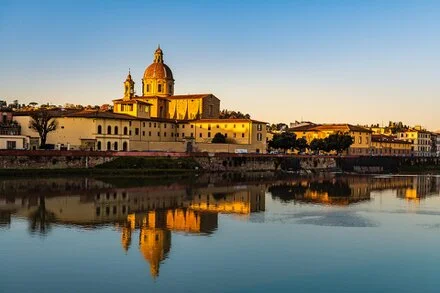
Nights Florence · Monteriggioni · Siena · Arezzo · Cortona
Three days to explore the heart of Tuscany: the Renaissance in Florence, the Middle Ages in Monteriggioni and Siena, the art of Piero della Francesca in Arezzo, and, to top it all off, Cortona from *Under the Tuscan Sun*.
Traditional lunches at restaurants every day, a wine and olive oil tasting at a farm, and local guides in every city.
Day 1 – Florence, the Cradle of the Renaissance (30 km)
Arrival in Florence in the morning and meeting with the guide. Founded by the Romans in 59 B.C. under the name Florentia (“the flourishing one”), it was the capital of Italy from 1865 to 1871. Under the Medici, from Cosimo the Elder to Lorenzo the Magnificent, it became the hub for artists, humanists, and bankers in the 15th century: masters like Giotto, Brunelleschi, Donatello, Botticelli, Leonardo, and Michelangelo worked here. The historic centre has been a UNESCO World Heritage Site since 1982.
The itinerary offers a broad overview of the Florentine Renaissance.
Visit to the Uffizi Gallery, originally built to house the offices (uffizi) of the Medici magistrates: Cosimo I commissioned Vasari to build it starting in 1560. The Vasari Corridor connects Palazzo Vecchio to Palazzo Pitti, passing over the Ponte Vecchio. In 1737, Anna Maria Luisa, the last of the Medici, donated the collections to the city on the condition that they never leave Florence. Don’t miss: Botticelli’s *The Birth of Venus* and *Spring*, Leonardo’s *Annunciation*, Michelangelo’s *Doni Tondo*, and Caravaggio’s *Medusa*.
Piazza della Signoria and Palazzo Vecchio, begun in 1299 based on a design by Arnolfo di Cambio, is still the seat of City Hall, and its tower is about 95 meters tall. The Loggia dei Lanzi is an open-air museum, featuring Cellini’s Perseus and Giambologna’s Rape of the Sabine Women. In front of the palace stands a copy of Michelangelo’s David (the original is in the Accademia Gallery). Ammannati’s Fountain of Neptune is known to the Florentines as “il Biancone.”
Ponte Vecchio was once home to butchers: in 1593, Grand Duke Ferdinand I had them replaced by goldsmiths and jewellers because the smell disturbed those passing through the Vasari Corridor. It was the only bridge in Florence spared by the retreating German troops in 1944.
Lunch at a restaurant.
In the afternoon, visit the Cathedral of Santa Maria del Fiore with Brunelleschi’s famous dome, a symbol of Florence’s wealth and cultural dominance. Together with Giotto’s Bell Tower (84.7 meters) and the Baptistery of St. John, the Cathedral forms the grand monumental complex of Piazza del Duomo.
Facts and trivia: Brunelleschi’s Dome (1420–1436) was built without a wooden framework, using bricks laid in a herringbone pattern, and remains the largest masonry dome ever constructed. To reach the top, you must climb approximately 460 steps.
At the end of the tour, check-in at a hotel in the Florence area. Dinner and overnight stay.
Traditional dishes: Florentine steak (made with Chianina beef, thick-cut and cooked rare), ribollita, pappa al pomodoro, Tuscan crostini, lampredotto (the iconic Florentine street food sandwich), and cantucci to dip in Vin Santo. Pair with: Chianti Classico (the red wine recognizable by the Black Rooster label).
Crafts: Jewelry from Ponte Vecchio, leatherwork (Santa Croce area), marbled paper, semi-precious stones, ceramics, and scagliola.
Practical Information: Admission to the Uffizi Gallery and Brunelleschi’s Dome requires a mandatory reservation with a specific time slot. The historic center is entirely a restricted traffic zone (ZTL) and off-limits to tour buses; therefore, it is necessary to arrange a passenger pick-up and drop-off point in advance (e.g., Lungarno Pecori Giraldi or Leopolda Station).
Day 2 – Monteriggioni and Siena (85 km)
Breakfast at the hotel, then departure for Monteriggioni, whose walls were built by Siena between 1214 and 1219 to control the border with Florence along the Via Francigena, the pilgrims’ route to Rome. The walls are 570 meters long and feature 15 towers.
Meet with the guide and tour the village (about 1 hour): the village we see today is practically the same as the original one. Entering through the medieval gate, you reach the large square, overlooked by the Romanesque parish church and the museum of medieval armor. The square also features mid- to high-end restaurants, shops selling local specialties, and souvenir shops.
Dante mentions Monteriggioni in *Inferno* (Canto XXXI), comparing its towers to the giants surrounding the well.
In July, the medieval festival “Monteriggioni Torri si Corona” takes place, featuring reenactments, a market, and musicians: it’s ideal if your tour coincides with that time of year.
The tour continues on to Siena. According to legend, it was founded by Senio and Aschio, sons of Remus, which is why its symbol is the Sienese she-wolf. The historic centre has been a UNESCO World Heritage Site since 1995 and retains its medieval layout almost intact.
Lunch at a restaurant featuring typical local dishes.
Traditional dishes: Pici with garlic sauce or Cinta Senese ragù, ribollita, pappardelle with wild boar, Cinta Senese cured meats, and pecorino cheese. Desserts: panforte, ricciarelli, cavallucci, and cantucci. Wines: Chianti Classico, Chianti Colli Senesi, and, for a more sophisticated tasting…Brunello di Montalcino.
In the afternoon, a guided city tour: the Basilica of San Domenico, an imposing Gothic brick structure, houses the sacred relic of the skull of Saint Catherine of Siena, patron saint of Italy and co-patron saint of Europe.
Via Banchi di Sopra, Piazza Salimbeni with the 14th-century Palazzo Salimbeni, the historic headquarters of Monte dei Paschi di Siena, founded in 1472 and considered the oldest bank in the world still in operation. Palazzo Tolomei, Via di Città, Piazza del Duomo with the Duomo, one of the most splendid examples of Italian Gothic architecture, the result of centuries of work.
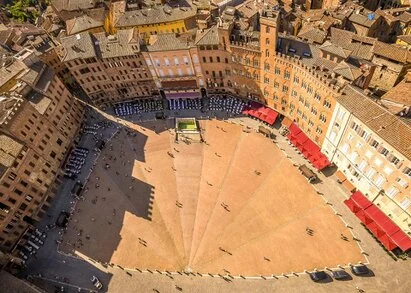
And finally, Piazza del Campo, with its shell-like shape, is paved with herringbone-patterned bricks and divided into nine segments; it slopes gently toward the Palazzo Pubblico, which still serves as the seat of the City Council and houses Simone Martini’s *Maestà* and Lorenzetti’s frescoes depicting *Good* and *Bad* Government. The Torre del Mangia (87 meters) owes its name to the first bell-ringer, Giovanni di Balduccio, nicknamed “Mangiaguadagni” because he spent everything he earned; according to tradition, it was designed so as not to exceed the height of the Cathedral, symbolizing the balance between civil and religious power.
In the centre of the square, the Fonte Gaia is a reproduction of the fountain by Jacopo della Quercia (1409–1419).
In the evening, before dinner, a wine and olive oil tasting at a farm near Siena. Check-in at the hotel, dinner, and overnight stay.
Facts and Trivia: The Palio di Siena takes place on July 2 (Madonna di Provenzano) and August 16 (Assunta). Ten of the 17 contrade participate, selected by lottery; the race is run bareback and lasts about a minute and a half. The prize is the Palio, a painted cloth banner. In Siena, each of the 17 contrade has its own animal or symbol, its own museum, a baptismal font, and a patron church.
Day 3 – Arezzo and Cortona (125 km)
After breakfast, departure for Arezzo, one of the major Etruscan cities (Arretium), which later became an important Roman centre. Mecenate, Guido Monaco (Guido d’Arezzo), Petrarca (1304), Giorgio Vasari, and Pietro Aretino were all born here.
Meet with the guide for the city tour, starting immediately on foot: the Pieve di Santa Maria Assunta, a masterpiece of Arezzo’s Romanesque architecture (12th–13th centuries). The façade consists of three orders of loggias with small columns, each one different from the others. The bell tower is known as “the one with a hundred holes,” even though it actually has 80 windows. Piazza Grande is unique for its slope, surrounded by buildings from different eras. The Logge del Vasari, the Palazzetto della Fraternita dei Laici, which blends Gothic and Renaissance styles, and its bell tower featuring a clock. Here, the history of the Giostra del Saracino, Arezzo’s traditional medieval tournament, will be explained.
Giostra del Saracino: This is a chivalric tournament held twice a year (the second-to-last Saturday in June and the first Sunday in September) among the four districts: Porta Crucifera, Porta del Foro, Porta Sant’Andrea, and Porta Santo Spirito. The knights strike the Buratto, a puppet representing the Saracen, with their lances.
The tour continues to the Cathedral and the Church of San Domenico, which houses Cimabue’s splendid painted Cross (1265–68), one of the first works to convey a new sense of Christ’s suffering and humanity, predating Giotto. Finally, the Basilica of St. Francis, where, through a stained-glass window, you can admire the frescoes from Piero della Francesca’s “True Cross” cycle, a Renaissance masterpiece (to view them up close, a paid admission ticket is required, and reservations are mandatory).
At the end of the tour, transfer to Cortona, one of Italy’s oldest Etruscan cities, situated on a hill about 650 meters high overlooking the Val di Chiana and Lake Trasimeno. This is the birthplace of the painter Luca Signorelli, to whom the main square is dedicated, and the Futurist Gino Severini. It is also the city of Santa Margherita, whose sanctuary overlooks the town centre, offering an exceptional view. Notable monuments include: the Etruscan Academy Museum (MAEC), which houses the famous Etruscan bronze lamp (4th century B.C.); the Diocesan Museum, featuring Beato Angelico’s “Annunciation”; as well as Piazza della Repubblica and Piazza Signorelli, the heart of the city.
Lunch at a restaurant and a stroll through the historic centre in the footsteps of the movie *Under the Tuscan Sun*.
Movie locations: Cortona is at the heart of the novel and the 2003 movie *Under the Tuscan Sun* by Audrey Wells, starring Diane Lane, which was also partially filmed in Sansepolcro. The book was written by Frances Mayes, an author who spends several months a year in Tuscany.
Traditional foods of Cortona: Chianina steak, pici with ragù, crostini neri, acquacotta, and Cortona DOC Syrah.
Practical notes: Cortona is located on a hill; for groups with mobility issues, we provide a shuttle service.