


TUSCANY
Pienza and Val D'Orcia
3 days
Pienza, stone villages, legendary wines, and thermal springs.
Day 1: Monte San Savino, the sculptor’s village (60 km me)
Our journey begins in Monte San Savino, a jewel of the Valdichiana enclosed within its city walls and guarded by two monumental gates. This ancient village reached its peak during the Renaissance and was the birthplace of Andrea Contucci, known as Sansovino, a sculptor and architect whose genius took him as far as Rome and Venice.
Don’t miss: the Cassero and the Tower, which, overlooking the Valdichiana from above, offer a view stretching as far as the eye can see over a mosaic of fields, rows of vines, and cypress trees. Palazzo di Monte, with its elegant courtyard and fountain; the Loggia dei Mercanti, with its Renaissance portico and ceramic shops.
For food lovers: the Valdichiana is home to the famous Chianina beef, a symbol of Tuscan cuisine.
In the afternoon, we’ll head to Chianciano Terme.
Dinner and overnight stay at the hotel. Those who still have energy can treat themselves to a stroll through Fucoli Park, among the fountains and the scent of the town’s thermal history.
Day 2: Montepulciano, Pienza, and Montalcino (150 km)
Montepulciano, the queen of wines
After breakfast, head up to a ridge straddling the Val d’Orcia and Valdichiana: Montepulciano, a town of graceful hills and stately mansions.
A tip: walk up to Piazza Grande, home to the Town Hall and the Cathedral, for a view that alone is worth the trip. Just outside the town, the Temple of San Biagio, a Renaissance masterpiece by Antonio da Sangallo il Vecchio, seems to blend seamlessly into the landscape.
This is where Vino Nobile di Montepulciano, one of Italy’s great red wines, is produced, alongside the younger Rosso di Montepulciano. Don’t miss the chance to taste these wines in a historic cellar carved into the tuff, surrounded by centuries-old barrels.
Pienza, the Ideal City
Arrival in Pienza, a UNESCO World Heritage Site. Enea Silvio Piccolomini, who was born here in 1405 and later became Pope Pius II, wanted to transform his hometown into the first ideal city of the Renaissance, entrusting the project to Bernardo Rossellino. The result is a harmonious blend of perspectives and light.
The highlights of the tour include Piazza Pio II, Palazzo Piccolomini with its rooftop garden overlooking the valley, and the Duomo, with its travertine façade. Also worth visiting are the Town Hall and the Bishop’s Palace, the Church of San Francesco, and Via dell’Amore and Via del Bacio: the scenic alleys overlooking the Val d’Orcia.
Pienza is also a film location: it served as the setting for Anthony Minghella’s *The English Patient*, which won nine Oscars. Nearby, the hills surrounding the Chapel of Vitaleta have also become famous thanks to *Gladiator*.
Lunch: This is the perfect time to try Pecorino di Pienza paired with honey and jams, pici with ragù or cacio e pepe.
Montalcino, the Kingdom of Brunello
In the afternoon, arrival in Montalcino, a medieval village dominated by a 14th-century fortress, from which the view stretches all the way to Mount Amiata.
Within the city walls, which still feature gates and towers, one finds: the Town Hall, a building dating from the late 13th century; the arcades of Piazza del Popolo, with 14th- and 15th-century arches; and the neoclassical cathedral, built on the site of an ancient 11th-century parish church.
Next are the 17th-century Sanctuary of the Madonna del Soccorso, Sant’Egidio, the church of the Sienese (14th century), Sant’Agostino, with 14th-century frescoes from the Sienese school, and San Francesco, with its cloisters.
Montalcino is synonymous with Brunello, one of the most prestigious wines in the world. A glass of wine at a wine bar, perhaps at sunset, is the best way to end the day
Return to the hotel for dinner and overnight.
Day 3: San Quirico, Bagno Vignoni, and Sant’Antimo (155 km)
San Quirico d’Orcia, the village on the Via Francigena
Located along the ancient pilgrims’ route, San Quirico has preserved its city walls almost intact, with 14 clearly visible defensive towers. From one corner of the square, you enter the Horti Leonini, a 16th-century Italian-style garden featuring geometric hedges and cypress trees.
Also worth seeing: the Collegiate Church, built on the site of a Romanesque parish church and featuring carved portals of rare finesse, and Palazzo Chigi, with its spectacular well.
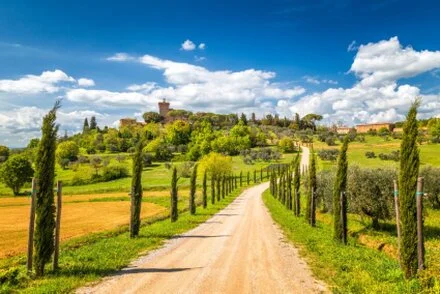
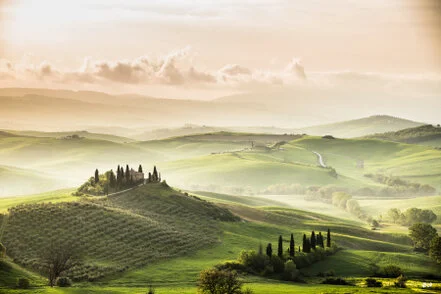
For photography enthusiasts: just a few minutes from the town, the cypress trees of Poggio Covili and the rolling hills along the Via Cassia are among the most iconic images of Tuscany.
Bagno Vignoni, the Water Square
Here we’ll see something truly unique: instead of a square, there’s a large pool of thermal water at 52°C, which steams on cool mornings. In the past, it was frequented by pilgrims, popes, and Saint Catherine of Siena, and even Lorenzo the Magnificent came here to seek healing.
Today, the village is a timeless place, perfect for a stop. The Parco dei Mulini features ancient mills carved into the rock.
The Abbey of Sant’Antimo, a Masterpiece of Silence
The afternoon continues with a visit to Sant’Antimo, nestled among olive and cypress trees, which, according to tradition, was founded by Charlemagne. It was later rebuilt during the Romanesque period using travertine and alabaster, which take on warm, golden hues at sunset. Inside, the carved capitals and the atmosphere of contemplation are particularly striking.
Today, a community of Premonstratensian canons of French origin lives there, celebrating Mass in Latin with Gregorian chant. If your visit coincides with a service, you’ll be enchanted.
• Best time to visit : spring, when the hills are lush and green, and fall, with the colours of the grape harvest. In June, the landscape is golden and perfect for photos.
• Souvenirs to take home: pecorino cheese, honey, olive oil, Vino Nobile or Brunello, and ceramics from Monte San Savino.