

TUSCANY
Pisa, Lucca, and the Land of Leonardo
4 days
Four days in Tuscany surrounded by beauty made of stone, water, history, and fine dining with… an extra travel companion: Leonardo da Vinci. We’ll encounter him at every stop, sometimes as the creator of a design, other times as a curious observer of nature.
Three nights in Lucca, a city that becomes intimate and quiet in the evening: unpack your suitcase just once and let yourself be guided by Leonardo’s genius.
Day 1: Pisa and Viareggio (65 km)
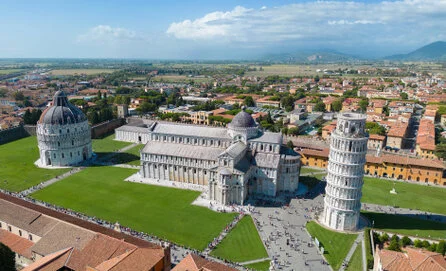
We begin in Pisa at the Campo dei Miracoli, where white marble structures seem to rest on the grass. The complex has been a UNESCO World Heritage Site since 1987.
Construction of the Leaning Tower began in 1173, and it started to lean while work was still underway. The unstable clay soil gave way on one side, and the builders attempted to compensate by adjusting the alignment of the upper floors. A major stabilization project, carried out between 1990 and 2001, reduced its tilt by about 45 cm. and secured the structure. Next to the Tower, you can visit the Cathedral, begun in 1064 by the architect Buscheto, with its façade of overlapping loggias. Then there’s the Baptistery, begun in 1152 and the largest in Italy: if you’re lucky, a custodian will sing beneath the dome to demonstrate its jaw-dropping acoustics.
A little trivia: the oft-told story of Galileo dropping two weights from the Tower is a fascinating tale, but it is not documented. Galileo, however, was indeed born in Pisa in 1564.
Leonardo in Pisa: The Man Who Wanted to Divert a River. Between 1503 and 1504, Florence was at war with Pisa. Leonardo, then an engineer in the service of the Florentine Republic, was involved in a daring plan: to divert the course of the Arno River to cut off Pisa’s access to the sea and isolate it. He studied the river, drew maps and channels, and work actually began, but the project failed and was abandoned.
From the marble sculptures, we move on to the Lungarno, where Santa Maria della Spina stands, a small Gothic gem on the riverbank. The name refers to a supposed thorn from Christ’s crown that is kept here. In 1871, to protect it from flooding, the church was dismantled piece by piece and rebuilt higher up.
At lunch, the Pisan cuisine immediately puts you in a good mood: cecina, a thin, golden flatbread made from chickpea flour and baked in a wood-fired oven; Pisan-style salt cod; and Pisan bread and vegetable soup. To finish, torta coi bischeri, a sweet tart typical of the region.
In the afternoon, head down to the coast toward Viareggio, where the atmosphere changes completely: the sea air and the Passeggiata, an open-air museum of Art Nouveau and Art Deco architecture. This is where the Carnival, famous for its large papier-mâché floats, was born in 1873, and since then the city has had its own mascot, Burlamacco, designed by Uberto Bonetti in the early 1930s.
Leonardo and the Sea. As we gaze at the horizon, it’s worth remembering that Leonardo was an obsessive observer of water, waves, eddies, and currents. In his manuscripts, water is one of the most recurring themes, and his drawings even include ideas for a device for breathing underwater and for webbed swimming gloves. These studies never made it past the drawing board, but they reveal a mind that viewed the sea as a laboratory.
If you love seafood: cacciucco alla viareggina or spaghetti allo scoglio are the perfect choices for enjoying the sunset. In the evening, return to Lucca for dinner and an overnight stay.
Day 2: Lucca and the Villas of Lucca (35 km)
After breakfast, we enter the city of Lucca, which managed to remain a small independent republic for centuries, until the Napoleonic era. The Renaissance city walls, built between the 16th and 17th centuries and stretching about 4 km., were never put to the test by a siege. Today, they form a tree-lined park suspended above the rooftops, where the people of Lucca stroll and cycle.
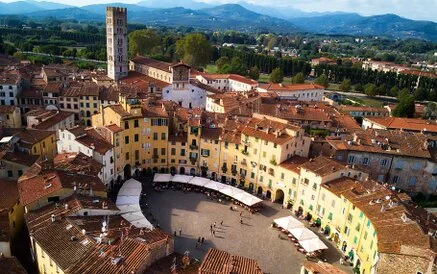
The tour begins at Piazza San Michele, on the site of the ancient Roman forum, featuring the Romanesque church with its loggia-style façade. Next is the Cathedral of San Martino, which houses the Volto Santo, the wooden crucifix that has been at the centre of the city’s devotion for centuries. You’ll stroll through the medieval streets, along the elegant Via Fillungo, past shops and antique dealers, until you reach the Guinigi Tower, which holds an unexpected gem: at the top, about 45 meters up, holm oaks grow, forming a hanging garden under the open sky. Piazza dell’Anfiteatro has an oval shape modelled after the Roman arena, now surrounded by medieval houses. The tour concludes at the Basilica of San Frediano, one of the oldest churches, with a facade adorned by a mosaic.
Lucca is also the birthplace of Giacomo Puccini, born in 1858.
Leonardo, the left-handed man. A stroll along the city walls is the perfect opportunity to discover one of the most beloved trivia facts about him. Leonardo was left-handed and wrote many of his notes from right to left, so that the text could only be read correctly in front of a mirror. The reasons for this are unclear: the most widely accepted explanation is practical, because writing this way with his left hand prevented the fresh ink from smudging. This “mirror-image” handwriting fills the thousands of pages of his manuscripts.
At lunch, you’ll sample Lucca’s cuisine: tortelli with meat sauce and spelt soup, a product that, in its Garfagnana variety, holds IGP certification. For dessert, buccellato, a sweet bread with raisins and anise.
In the afternoon, we’ll head to Camigliano to visit Villa Torrigiani, a splendid Baroque villa with furnished interiors and a garden full of surprises, including water features.
Here, too, our thoughts turn to Leonardo, who spent his entire life designing canals, locks, and hydraulic machines. The connection to Villa Torrigiani is purely speculative and undocumented, but it helps illustrate just how highly regarded hydraulic engineering was during the Renaissance.
We continue on to Marlia, to the Villa Reale, associated with Elisa Baciocchi, Napoleon’s sister, who governed the Lucca region beginning in 1805. The park is vast and spectacular, and its highlight is the “theater of greenery” a stage created entirely from vegetation where, according to tradition, the violinist Niccolò Paganini once performed. The interior of the villa is not open to the public, but the park alone makes the day worthwhile.
Dinner and overnight stay in Lucca.
Day 3: Pistoia and Vinci (150 km)
Today is Leonardo’s day, with a bit of a drive ahead to reach two places that reveal two different sides of Tuscany. We’re heading to Pistoia, Italy’s Capital of Culture in 2017, which never fails to surprise those discovering it for the first time.
At its heart lies Piazza del Duomo, which has been the centre of civil and religious power for centuries. The Cathedral of San Zeno houses the silver altar of San Jacopo, a masterpiece of goldsmithing created over the course of more than two centuries: among the goldsmiths who worked on it was a young Filippo Brunelleschi, the future architect of Florence’s dome. Next to it stands the bell tower, about 67 meters tall, built on the foundation of an ancient Lombard tower. Surrounding it are the Gothic Baptistery, built of white and green marble; the Palazzo Pretorio, with its courtyard covered in the coats of arms of the magistrates; and the Palazzo del Comune. Just a short walk away, Piazza della Sala still serves as the city’s produce market, featuring the well known as “del Leoncino.” Don’t miss the Ospedale del Ceppo, with its glazed terracotta frieze by the della Robbia family.
A thread leading to Leonardo. Upon entering the Cathedral, one finds the *Madonna di Piazza*, a work created in the Florentine workshop of Andrea del Verrocchio, the master under whom Leonardo trained. Leonardo joined the workshop as a boy and remained there for years, learning painting, sculpture, goldsmithing, and mechanics—an education that explains his versatility. There is no documented evidence of his work in Pistoia, but it was the artistic milieu from which he emerged.
Here you can get a taste of mountainous Tuscany: necci, thin crêpes made from chestnut flour, and zuccherini, small traditional pastries. And for nature lovers, Pistoia is also one of Europe’s most important nursery districts.
In the afternoon, we arrive in Vinci, the town where everything seems to revolve around one name.
Little Leonardo. Leonardo was born on April 15, 1452, in the nearby hamlet of Anchiano. He was the illegitimate son of Ser Piero, a notary, and Caterina, a young woman of modest means. We know the exact time of his birth—around three in the morning—because his grandfather Antonio recorded it in writing. The same note mentions his baptism and godparents, and tradition links him to the Church of Santa Croce in Vinci. “da Vinci” is not a last name but simply means “from Vinci,” that is, his town of origin.
At the Leonardo Museum, housed in the Castello dei Conti Guidi and the Palazzina Uzielli, visitors can gain a tangible understanding of his genius: there are working models of his machines, reconstructed from his drawings.
A few more interesting facts to liven up the bus ride:
• The Mona Lisa. The portrait housed at the Louvre is traditionally identified as Lisa Gherardini, wife of the Florentine merchant Francesco del Giocondo.
• Flight. Leonardo studied the flight of birds at length—the subject of his *Codex on the Flight of Birds* from 1505–06—and designed flying machines that were never built in his lifetime.
For a taste of the region, try a drizzle of Tuscan extra-virgin olive oil on plain bread and a glass of Montalbano or Carmignano wine. Return to Lucca for dinner and overnight stay.
Day 4: Prato (75 km)
The last day is dedicated to Prato, a city many know for its textile industry. The city grew out of a medieval settlement that developed around the parish church and the castle, and for centuries it has been the wool capital of Tuscany.
We begin with the Emperor’s Castle, built around 1240 for Frederick II of Swabia: it is the only example of Swabian architecture in central and northern Italy, and the keep that connected it to the city walls can still be walked through. Next is the Basilica of Santa Maria delle Carceri, a Renaissance church with a Greek cross plan, begun in 1484 by Giuliano da Sangallo, featuring glazed terracotta works by Andrea della Robbia.
Leonardo and the “perfect” church. The central Greek cross plan was the architectural ideal of the Renaissance, and Leonardo devoted study drawings to it in his manuscripts, particularly in Manuscript B, which contains designs for churches with a central plan.
In the Cathedral of Santo Stefano, the outdoor pulpit by Donatello and Michelozzo (1428–1438) was designed to display the Sacred Belt—the Marian relic venerated in the city—to the faithful. Inside, the frescoes by Filippo Lippi feature the famous scene of Salome’s dance. Also worth visiting is Piazza del Comune, with the Bacchino Fountain.
Leonardo and textiles. Prato is the city of textiles, and even Leonardo was involved in the field: his manuscripts contain drawings of machines for processing cloth.
For lunch, the finale is sweet and savory: Prato IGP mortadella, pink in color and scented with Alchermes; “bozza pratese” is the local bread. To finish, cantuccini—which have a long history here—are dipped in Vin Santo.
After lunch, we said our goodbyes and left, still feeling the spirit of Tuscany and… a touch of Leonardo.